Innovii Digital Service
The river’s maize held a floor at $18 a Loor, closed at $23 — and the gap to the city closed.
Now monthly, on the 1st.
The month in four numbers
 The story · page 5Full Stores, Empty PocketsAfgooye’s good Gu harvest is paying the people who can wait, not the people who grew it.Read the story page →
Showing the story page. The rest of the issue is below.


Between 26 September and 31 October white maize at Afgooye stayed inside a $7 band — $18 to $25 a Loor — after falling from $55 since 1 August. It touched $18 twice, on 6 October and again on 28 October, and closed the month at $23. Bakaaro came down from $35 to $28.50, so the spread between the river and the capital fell from $15 to $5.50 on the same sack. Baidoa closed dearest of the three at $29. Sesame met in the middle: up 20% on the river, down 40% in Bay, both at $1.20 a kg. This first monthly issue reads the floor, the turn, and who gets paid for waiting.
The maize line
Three months of the Loor: $55 in August, an $18 floor in October
All three markets quote white maize by the Loor, so the lines compare directly. Afgooye opened collection at $55 on 1 August, touched $65 on the 4th, halved as the Gu harvest came in, and has not been above $35 since mid-September. This window it found a floor and then left it: $20 on 26 September, $18 on 6–7 October, up to $24–25 from 8 to 19 October, back to $18 on 28 October, and $23 on the 31st. Bakaaro held $35 at the start of the window, dropped to $26 on 28 September and $20 on 5 October, climbed back to $28.50 by the 10th and closed there. Baidoa fell from $35 to $18 on 4 October, held $18 for ten days — the fortnight after fighting in the city — then recovered to $26–28 and closed at $29, the dearest of the three.
Swipe sideways to see the rest →Closing price per Loor, US$. Afgooye 1 Aug – 31 Oct; Baidoa 5 Aug – 30 Oct; Bakaaro 22 Aug – 31 Oct. Lines join observed days only.
What the floor means
Afgooye maize spent the month between $18 and $25. A storer who bought at $18 on 6 October could sell at $25 four days later — a 39% gain in under a week, the trade described in the story below. And the month ended with the market rising: Afgooye went $18 to $23 in three days and Baidoa $22 to $29. The spread between the river and the capital, $15 on 25 September, was $5.50 on 31 October.
Between markets
| Crop | Measure | Afgooye | Baidoa | Bakaaro | Read |
|---|---|---|---|---|---|
| Maize (Galleey), white | per Loor | 23.00 | 29.00 | 28.50 | Afgooye cheapest, 21% under |
| Sorghum (Moordi), red | per Loor | 23.00 | 22.00 | 29.50 | Baidoa cheapest, 25% under |
| Cherry tomato (Yaanyo) | per Jirgaan | 9.00 | 10.00 | 9.00 | two markets level |
| Cowpea (Digir) | per Koombo | 0.60 | 0.80 | 1.70 | Afgooye cheapest, 65% under |
| Mung bean (Salbuko) | per Koombo | 0.75 | 0.80 | 1.00 | Afgooye cheapest, 25% under |
| Sesame (Sisin) | per kg | 1.20 | 1.20 | 2.00 | two markets level |
| Watermelon (Qare) | per piece | 2.00 | 2.00 | 2.50 | two markets level |
A month ago every cereal and pulse was cheapest at Afgooye, and the river sat $15 under the capital on a sack of maize. It is still the cheapest place to buy grain, but by $5.50 now, not $15. Baidoa closed dearest on maize for the first time since collection began. Tomatoes are within $1 across the three markets — there is no margin in moving them.
Prices this period
First and latest observation inside 26 September – 31 October, plus the full range. Never a period average. All prices US$ in the measure the market actually trades. Three markets, 36 days, 1,728 price records.
| Crop | Measure | First | Latest | Change | Range in period |
|---|---|---|---|---|---|
| Maize (Galleey), white | Loor | 20.00 | 23.00 | ▲ +15.0% | 18.00 - 25.00 |
| Sorghum (Moordi), red | Loor | 21.00 | 23.00 | ▲ +9.5% | 17.99 - 24.00 |
| Cowpea (Digir) | Koombo | 0.70 | 0.60 | ▼ -14.3% | 0.60 - 0.80 |
| Mung bean (Salbuko) | Koombo | 0.80 | 0.75 | ▼ -6.3% | 0.75 - 0.80 |
| Sesame (Sisin) | kg | 1.00 | 1.20 | ▲ +20.0% | 1.00 - 1.50 |
| Wheat (Qamadi) | Koombo | 0.60 | 0.60 | ● no change | 0.60 - 0.60 |
| Crop | Measure | First | Latest | Change | Range in period |
|---|---|---|---|---|---|
| Maize (Galleey), white | Loor | 35.00 | 29.00 | ▼ -17.1% | 18.00 - 35.00 |
| Sorghum (Moordi), red | Loor | 25.00 | 22.00 | ▼ -12.0% | 18.00 - 28.00 |
| Cowpea (Digir) | Koombo | 1.00 | 0.80 | ▼ -20.0% | 0.50 - 1.00 |
| Mung bean (Salbuko) | Koombo | 0.90 | 0.80 | ▼ -11.1% | 0.80 - 0.90 |
| Sesame (Sisin) | kg | 2.00 | 1.20 | ▼ -40.0% | 1.20 - 2.00 |
| Wheat (Qamadi) | Koombo | 0.80 | 1.00 | ▲ +25.0% | 0.60 - 1.00 |
| Crop | Measure | First | Latest | Change | Range in period |
|---|---|---|---|---|---|
| Maize (Galleey), white | Loor | 35.00 | 28.50 | ▼ -18.6% | 20.00 - 35.00 |
| Sorghum (Moordi), red | Loor | 25.20 | 29.50 | ▲ +17.1% | 22.00 - 29.50 |
| Cowpea (Digir) | Koombo | 0.80 | 1.70 | ▲ +112.5% | 0.70 - 1.70 |
| Mung bean (Salbuko) | Koombo | 1.00 | 1.00 | ● no change | 1.00 - 1.00 |
| Sesame (Sisin) | kg | 2.00 | 2.00 | ● no change | 2.00 - 2.00 |
| Wheat (Qamadi) | Koombo | 0.60 | 1.00 | ▲ +66.7% | 0.60 - 1.00 |
All six cereals and pulses are tabled for all three markets this issue. Sesame was not on sale on 15 of 36 days at Baidoa and 5 of 36 at Bakaaro; those tables show priced days only.
| Crop | Market | Measure | First | Latest | Change |
|---|---|---|---|---|---|
| Cherry tomato (Yaanyo) | Afgooye | Jirgaan | 9.00 | 9.00 | ● no change |
| Cherry tomato (Yaanyo) | Bakaaro | Jirgaan | 9.00 | 9.00 | ● no change |
| Cherry tomato (Yaanyo) | Baidoa | Jirgaan | 11.00 | 10.00 | ▼ -9.1% |
| Watermelon (Qare) | Afgooye | piece | 3.50 | 2.00 | ▼ -42.9% |
| Watermelon (Qare) | Baidoa | piece | 3.00 | 2.00 | ▼ -33.3% |
| Watermelon (Qare) | Bakaaro | piece | 4.00 | 2.50 | ▼ -37.5% |
| Spinach (Isbinaash) | Baidoa | Xirmo bac | 2.50 | 1.00 | ▼ -60.0% |
| Spinach (Isbinaash) | Bakaaro | Xirmo bac | 2.50 | 3.50 | ▲ +40.0% |
| Potato (Baradho) | Baidoa | kg | 0.75 | 0.65 | ▼ -13.3% |
| Potato (Baradho) | Bakaaro | kg | 0.75 | 1.00 | ▲ +33.3% |
| Onion (Basal), red | Afgooye | kg | 1.25 | 0.50 | ▼ -60.0% |
| Onion (Basal), red | Baidoa | kg | 0.80 | 0.65 | ▼ -18.8% |
| Carrot (Karooto) | Baidoa | Xirmo bac | 0.75 | 1.50 | ▲ +100.0% |
| Carrot (Karooto) | Bakaaro | Xirmo bac | 2.00 | 2.50 | ▲ +25.0% |
How to read the tables
First and Latest are the recorded closing price on the first and last day of the window; Range is the lowest and highest quote inside it. ▲ marks a price that rose; ▼ a price that fell. Read the colour from your side of the trade: a rising price favours the farmer or trader with produce to sell, a falling price favours the buyer stocking up. Watermelon closed at $2 a piece in all three markets; red onion held $0.75–0.80 a kg at Baidoa and Bakaaro.
Against last year
Reference: Sicirka Suuqa ee Dalaga Beeraha, Warbixin 5.6, Wasaaradda Beeraha iyo Waraabka (FGS Ministry of Agriculture and Irrigation), 8–14 August 2025 — the last weekly issue published, now eleven weeks earlier in the season than our window. Grain Loor converted at 75 kg. Jowhar is the riverine reference for Afgooye.
| Crop | Market (2026) | 31 Oct 2026 $/kg | Reference (Aug 2025) | Aug 2025 $/kg | Change |
|---|---|---|---|---|---|
| Maize, white | Afgooye | 0.31 | Jowhar | 0.43 | ▼ -28% |
| Maize, white | Baidoa | 0.39 | Beydhabo | 0.27 | ▲ +44% |
| Maize, white | Bakaaro | 0.38 | Muqdisho | 0.60 | ▼ -37% |
| Sorghum, red | Baidoa | 0.29 | Beydhabo | 0.24 | ▲ +21% |
| Sorghum, red | Bakaaro | 0.39 | Muqdisho | 0.60 | ▼ -35% |
| Sesame | Afgooye | 1.20 | Jowhar | 0.86 | ▲ +40% |
| Sesame | Baidoa | 1.20 | Beydhabo | 1.30 | ▼ -8% |
| Onion, red | Baidoa | 0.65 | Beydhabo | 1.00 | ▼ -35% |
| Potato | Baidoa | 0.65 | Beydhabo | 0.58 | ▲ +12% |
| Potato | Bakaaro | 1.00 | Muqdisho | 1.00 | ● no change |
How to read it — the zone gap has swapped ends
Afgooye maize is 28% under the Jowhar reference, Baidoa 44% above its own and the capital 37% under. Sesame is 40% over the Jowhar reference on the river and 8% under the Beydhabo reference in Bay.
Where we are in the season
FEWS NET (September 2026): Deyr land preparation and dry planting under way in most agro-pastoral areas, while many riverine farmers hold back for fear of floods. ICPAC’s outlook for October–December remains wetter than normal over southern Somalia; SoDMA’s 1 September alert put some areas above 400 mm for the season. The Gu 2026 harvest is above the long-term average nationally — that is the grain in Afgooye’s stores, priced at $23 a Loor at the end of October.
Security context, Baidoa
Armed clashes in Baidoa on 28 September – 3 October displaced more than 5,600 people (UNHCR Flash Alert #24, 6 October 2026). Baidoa maize went $35 → $11 → $28 → $22 and sorghum $25 → $11 → $28 → $18 inside the month. Read October’s Baidoa prices as a disrupted market, not as the season.
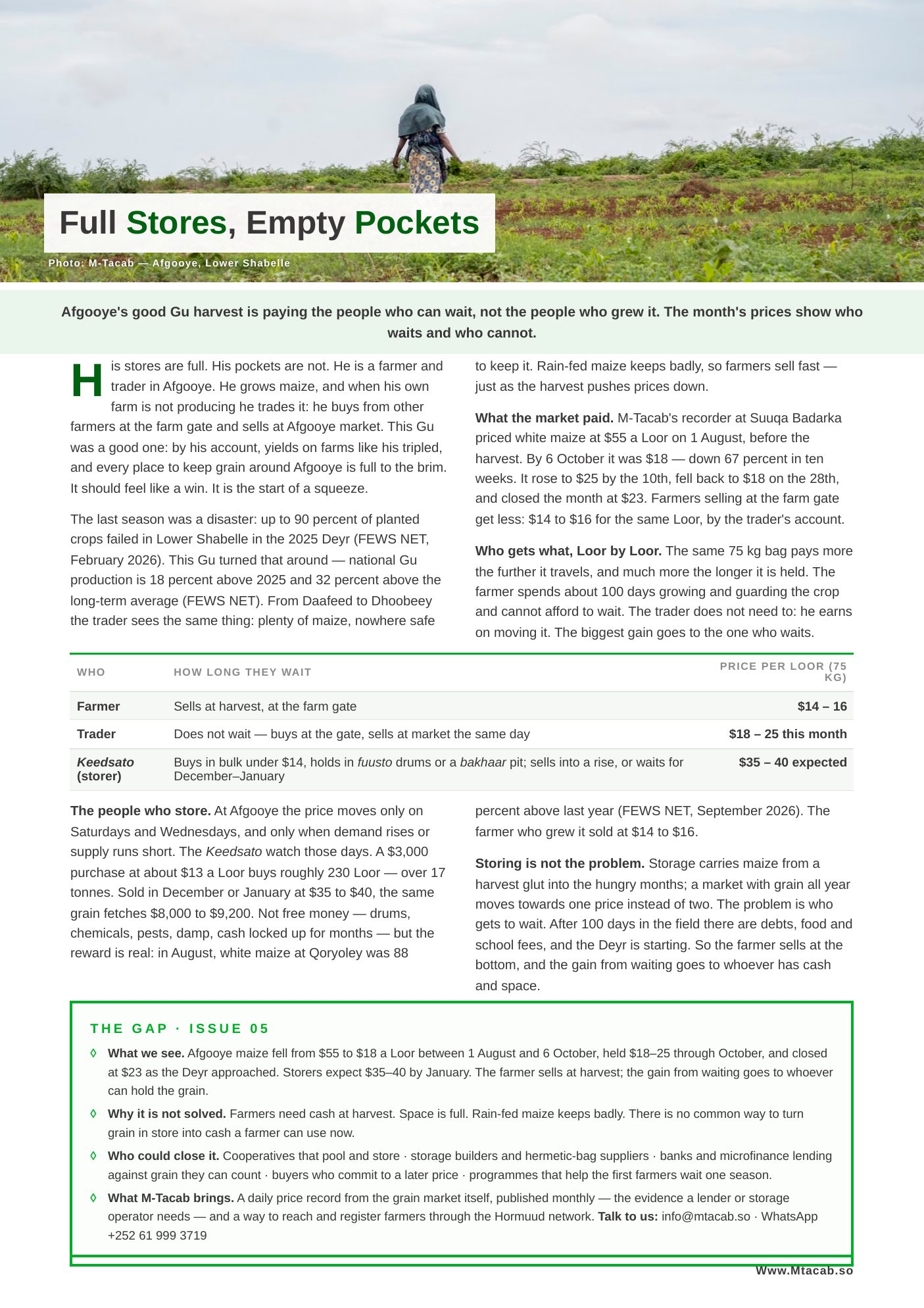
Full Stores, Empty Pockets
Afgooye’s good Gu harvest is paying the people who can wait, not the people who grew it.
His stores are full. His pockets are not. He is a farmer and trader in Afgooye. He grows maize, and when his own farm is not producing he trades it: he buys from other farmers at the farm gate and sells at Afgooye market. This Gu was a good one: by his account, yields on farms like his have tripled, and every place to keep grain around Afgooye is full to the brim. It should feel like a win. It is the start of a squeeze.
A good harvest, after a failed one
The last season was a disaster. In the 2025 Deyr, up to 90 percent of planted crops failed in Lower Shabelle, and the region’s harvest came in at 8 percent of its long-term average (FEWS NET, February 2026). This Gu turned that around. FEWS NET puts Gu 2026 crop production 18 percent above 2025 and 32 percent above the long-term Gu average, with deficits still in some major basins. His “tripled” and FEWS NET’s “18 percent” measure different things: he is comparing his own fields with a failed year; FEWS NET is measuring the whole country’s Gu.
Lower Shabelle is Somalia’s main maize-producing region, and Afgooye sits about 30 km from Mogadishu. From Daafeed to Dhoobeey, and in villages up to 7 km outside town, the trader sees the same thing: plenty of maize, nowhere safe to keep it. Rain-fed maize draws pests and keeps badly, so farmers sell fast — just as the harvest pushes prices down.
What the market paid
M-Tacab’s recorder at Suuqa Badarka, Afgooye’s grain market, priced white maize at $55 a Loor (75 kg) on 1 August, before the harvest came in. By 6 October it was $18 — a fall of 67 percent in ten weeks. It rose to $25 by the 10th, fell back to $18 on the 28th, and closed the month at $23. Farmers who sell at the farm gate get less: $14 to $16 for the same Loor, by the trader’s account. Traders buy at the gate and sell at the market straight away. The rise from $18 on 7 October to $25 on the 10th is the kind a storer sells into.
Who gets what, Loor by Loor
| Who | How long they wait | Price per Loor (75 kg) |
|---|---|---|
| Farmer | Sells at harvest, at the farm gate | $14 to $16 |
| Trader | Does not wait — buys at the farm gate, sells at market the same day | $18 to $25 this month |
| Keedsato (storer) | Buys in bulk under $14, then watches the market: sells on a rise, or holds for the high-demand months | $35 to $40, or more, in December–January |
The farmer spends about 100 days growing the crop and guarding it from birds, pests and thieves — and cannot afford to wait. The trader does not need to: he earns on moving the grain. The biggest gain goes to the one who waits.
The people who store
The Keedsato — the storers, or savers, of produce — buy in volume at harvest and pay under $14 a Loor. They keep the grain in fuusto drums or in a bakhaar, the underground pit, treat it with pest-control chemicals, and wait. Which chemicals, and how much, nobody records.
At Afgooye, the price can move only on two days a week, Saturdays and Wednesdays — and only when demand rises or supply runs short. The Keedsato watch for those days. Some sell into a short rise. Others hold for the months when demand is highest — in this season, December and January, before the Deyr harvest arrives.
They read the season well. A $3,000 purchase at about $13 a Loor buys roughly 230 Loor — over 17 tonnes. Sold in December or January at $35 to $40, the same grain fetches about $8,000 to $9,200. That is not free money. The storer pays for drums, chemicals and space, risks losses to pests and damp, and has cash locked up — for weeks or for months — with no guarantee prices will rise. But the reward for waiting is real: in August, white maize at Qoryoley in Lower Shabelle was 88 percent above last year and 56 percent above its five-year average (FEWS NET, September 2026). The farmer who grew the grain sold it for $14 to $16. That is between a third and a little under half of what it fetches in January.
Storing is not the problem
Storage is what carries maize from a harvest glut into the hungry months. The more people who store, the more grain is held back at harvest and released later — and over time, a market with grain all year round moves towards one price instead of two.
The problem is who gets to wait. The farmer usually cannot. After 100 days in the field there are debts to clear, food to buy and school fees due, and the next season starts with the Deyr rains now arriving. So the farmer sells at the bottom, and the gain from waiting goes to whoever has cash and space.
Issue 02 (“The Harvest With Nowhere to Sleep”) showed how much grain is lost when there is nowhere safe to keep it, and that chemical-free storage already works in Somalia. This issue is about the money: even when the grain survives, the farmer is rarely the one who keeps it.
The clock
FEWS NET reports Deyr land preparation and dry planting under way in most agro-pastoral areas, while many riverine farmers are holding back for fear of floods (September 2026). The Keedsato calendar ends where the Deyr harvest begins: they sell in December and January, before new grain reaches the market.
The gap · Issue 05
What we see. Afgooye maize fell from $55 to $18 a Loor between 1 August and 6 October, held $18–25 through October, and closed at $23 as the Deyr approached. Storers expect $35–40 by January. The farmer sells at harvest; the gain from waiting goes to whoever can hold the grain.
Why it is not solved. Farmers need cash at harvest. Space is full. Rain-fed maize keeps badly. There is no common way to turn grain in store into cash a farmer can use now.
Who could close it. Cooperatives that pool and store together · storage builders and hermetic-bag suppliers · banks and microfinance lending against grain they can count · buyers who commit to a later price · programmes that help the first farmers wait one season.
What M-Tacab brings. A daily price record from the grain market itself, published monthly — the evidence a lender or storage operator needs to see the season’s swing — and a way to reach and register farmers through the Hormuud network. Talk to us: info@mtacab.so · WhatsApp +252 61 999 3719
Next month, watch
Whether the turn holds. Every market rose in the last days of October — Afgooye $18 to $23, Baidoa $22 to $29. If that is the storers buying before December, November keeps climbing. If it is a one-week blip, prices fall back to $18–20.
Whether Baidoa stays above the capital. Baidoa closed at $29 against Bakaaro’s $28.50 — the first time Bay has been the dearest of the three. Read October’s Baidoa prices as a disrupted market, not as the season.
The river. On 17 October SWALIM measured the Shabelle at Jowhar at 5.36 m, above the 5.25 m danger level. Afgooye is on SoDMA’s Deyr flood-risk list. If the river comes over the bank in November, it shows in the maize table first.
What to do with this, if you farm
Cereal growers, riverine: $23 at Afgooye against $28.50 at Bakaaro is a $5.50 gap — a third of what it was in September. A lorry to Mogadishu no longer pays for itself on one sack. Your own market rose $5 in the last three days of October; if you can hold, hold.
Cereal growers, Bay: Baidoa maize went $35 to $18 and back to $29 inside one month. Do not price a decision on one week’s quote; wait for two market days in a row at the same level.
Sesame growers: both production markets closed at $1.20 a kg — Afgooye up from $1.00, Baidoa down from $2.00. Bakaaro still pays $2.00. For the first time this season the margin is in moving sesame to the capital, not between the two production zones.
Vegetable growers: tomatoes closed $9, $10 and $9 a Jirgaan across the three markets — no margin in moving them. Whatever goes in now for the Deyr goes in under a flood warning: keep nurseries off the bank.
Based on price observation only. Not agronomic advice; no chemical, pesticide or veterinary guidance is given here. Flood guidance follows SoDMA and SWALIM advisories; monitor official alerts.
Coming next
Results of the September measurement study — a verified kilogram weight for every measure in the register — follow once the analysis is complete. The full month’s price series, by crop, market and day, is available as a spreadsheet on request: mtacab.so/contact.
How we measure
Prices are collected daily by M-tacab recorders at Suuqa Badarka Afgooye, Baidoa City Market and Bakaaro Market, Mogadishu, in the measures the markets trade in. Where a trader gave a low–high range, the closing quote is recorded and the range kept. Missing days and days with no supply are recorded as such, never estimated. Comparisons to 2025 use the Ministry of Agriculture and Irrigation’s last published weekly bulletin (Warbixin 5.6, 8–14 August 2025) as the reference; the window mismatch is stated where it applies.
Sources this issue: M-tacab daily collection, 1 August–31 October 2026 · Wasaaradda Beeraha iyo Waraabka JFS, Sicirka Suuqa ee Dalaga Beeraha, 8–14 August 2025 · FEWS NET, Somalia Food Security Outlook, February 2026, and Key Message Update, September 2026 · ICPAC, GHACOF 74 statement, August 2026 · SoDMA, El Niño alert, 1 September 2026 · SWALIM river-level reporting, Jowhar, 17 October 2026 · UNHCR Somalia, Flash Alert #24, 6 October 2026 · interview with a farmer and trader, Afgooye, October 2026. Photography: M-Tacab field photography, September 2026.
Sources. Prices: M-tacab daily market price collection, Afgooye (Suuqa Badarka Afgooye), Bakaaro market (Mogadishu) and Baidoa city market, 26 September–31 October 2026, as held on the M-tacab platform. Comparison series: Federal Government of Somalia, Ministry of Agriculture and Irrigation, Department of Agribusiness, Sicirka Suuqa ee Dalaga Beeraha, July–August 2025.
Caveats. All prices are asking prices in US dollars, quoted in the local measure as recorded. This bulletin contains no agronomic, chemical or veterinary recommendations. Somali localisation required before farmer-facing distribution.
M-tacab is a Somali-led agricultural value-chain platform operated by Innovii Digital Service, Mogadishu. mtacab.so · info@mtacab.so · USSD *141*6# · Next issue: 1 December 2026